The North Atlantic Population Project (NAPP) is a collaboration of historical demographers in Britain, Canada, Denmark, Germany, Iceland, Norway, and Sweden to produce a massive census microdata collection for the North Atlantic Region in the late-nineteenth century. The database includes complete individual-level census enumerations for each country, and provides information on over 110 million people. This large scale allows detailed analysis of small geographic areas and population subgroups. The NAPP database is designed to be compatible with the Integrated Public Use Microdata Series (IPUMS), and is disseminated through the IPUMS data-access system at the Minnesota Population Center, University of Minnesota. Major collaborators on the project include Lisa Dillon, University of Montreal; Chad Gaffield, University of Ottawa; Ólöf Garðarsdóttir, Statistics Iceland; Marianne Jarnes Erikstad, University of Tromsø; Jan Oldervall University of Bergen; Evan Roberts, University of Minnesota; Steven Ruggles, University of Minnesota; Kevin Schürer, UK Data Archive; Gunnar Thorvaldsen, University of Tromsø; and Matthew Woollard, UK Data Archive. The project is also coordinated by the Minnesota Population Center at the University of Minnesota.
Dental AI
Dental artificial intelligence (Dental AI) refers to the application of artificial intelligence (AI) and machine-learning methods to oral healthcare data. These systems can be used to find patterns or make predictions that can aid in diagnosis, treatment, patient communication, or practice management. == History and development == Research into AI for dentistry dates to the 1990s and 2000s, alongside early CAD/CAM and image-analysis work in dental radiology. Recent developments in deep learning, especially those involving computer vision, such as convolutional neural networks, trained on large image datasets, led to a rapid improvement in performance, as well as a move from prototype technology to productization suitable for use in dental chairs. Dental schools and continuing education programs started incorporating AI content in the 2020s. == Definition and core technologies == The dental AI software accomplishes this task by using various dental images and patient data. Dental images and data used by the dental AI software include bitewing and periapical X-rays, complete mouth X-rays, detailed 3D images, intraoral images, and the patient’s medical history. The dental AI software utilizes several core technologies in accomplishing its task of assisting the dentist. First, the dental AI software utilizes machine learning and deep learning using programs that can learn from examples. Such programs are referred to as convolutional neural network (CNN) and can detect cavities and identify bone changes related to gum disease. The dental AI software utilizes computer vision, which enables the AI software to identify and quantify important features in images and data, whether they are 2D images or 3D images. Natural language processing (NLP) is used for the AI software to understand written text and can automatically generate dental notes and communicate with the patient. Furthermore, the dental AI software utilizes predictive analytics to identify patients that are more prone to dental complications and can suggest the best intervals for checkups or future dental procedures. == Applications in dentistry == Reported clinical and operational applications include diagnostic assistance for caries and periodontal disease, treatment planning assistance, patient education overlays, quality assurance, curriculum assistance for dental education, and claims documentation. Systematic reviews continue to find image-based applications such as caries detection with some variability in study design and a need for prospective validation. == Academic research and clinical validation == Several peer-reviewed studies have measured the effectiveness of AI for applications such as interproximal caries detection and periodontal bone level assessment, showing improvements over unaided readings with a focus on bias within the dataset. The Dental AI Council found variability among clinicians for diagnosis and treatment planning, suggesting the use of a standard tool as an assist. == Industry adoption == Multiple vendors offer FDA-cleared chairside AI for dental imaging: Pearl — Received U.S. FDA 510(k) clearance for its real-time radiologic aid (“Second Opinion”) in 2022 (2D), with subsequent clearances including pediatric and CBCT (“Second Opinion 3D”). TIME gave “Second Opinion” a special mention on its Best Inventions of 2022 list. Overjet — FDA-cleared for bone-level quantification and detection/outline of caries and calculus (e.g., K210187), with additional clearances expanding capabilities. VideaHealth — Received an FDA 510(k) covering 30+ detections across common dental findings (K232384), including indications for patients ages 3 and up; trade coverage has described elements of this as the first pediatric dental-AI clearance. == Regulations == In the U.S., AI-enabled dental imaging software is generally reviewed via the FDA’s 510(k) pathway. The FDA maintains a public AI-Enabled Medical Devices List, which includes numerous medical-imaging AI tools (including dental). Specific dental clearances include Overjet (K210187), VideaHealth (K232384), and Pearl entries such as “Second Opinion 3D” (K243989).
Julia Hirschberg
Julia Hirschberg is an American computer scientist noted for her research on computational linguistics and natural language processing. She received her first PhD in history from the University of Michigan and the second from the University of Pennsylvania in computer science doing research in Natural Language Processing. She worked at Bell Labs and AT&T Bell Labs from 1985 to 2002 and from 2002 at Columbia University where she is currently the Percy K. and Vida L. W. Hudson Professor of Computer Science. == Biography == Julia Linn Bell Hirschberg received her first Ph.D. degree in history (16th-century Mexico) from University of Michigan in 1976. She served on the History faculty of Smith College from 1974 to 1982. She subsequently shifted to Computer Science studies, receiving her M.S. in Computer and Information Science from University of Pennsylvania in 1982 and a Ph.D. in Computer and Information Science from University of Pennsylvania in 1985. Upon graduation from University of Pennsylvania in 1985, Hirschberg joined AT&T Bell Labs as a Member of Technical staff in the Linguistics Research Department, where she worked on improving prosody assignment for Text-to-Speech Synthesis (TTS) in the Bell Labs TTS system. She was promoted to Department Head in 1994 when she created a new Human Computer Interface Research Lab. She and her department remained at Bell Labs until 1996 when they moved to AT&T Labs Research as part of a corporate reorganization. In 2002, she joined the Columbia University faculty as a professor in the Department of Computer Science. She served as Chair of the Computer Science Department from 2012 to 2018. She still leads classes at Columbia in speech and natural language research and supervises PhD students and a large number of research project students. == Research == Hirschberg's research has included prosody, discourse structure, conversational implicature, text-to-speech synthesis, speech summarization, spoken dialogue systems, emotional speech, deceptive speech, charismatic speech, entrainment, empathetic speech and code-switching. Hirschberg was among the first to combine Natural Language Processing (NLP) approaches to discourse and dialogue with speech research. She pioneered techniques in text analysis for prosody assignment in Text-to-Speech synthesis at Bell laboratories in the 1980s and 1990s, developing corpus-based statistical models based upon syntactic and discourse information which are in general use today in TTS systems. With Janet Pierrehumbert, she developed a theoretical model of intonational meaning. She was a leader in the development of the ToBI conventions for intonational description, which have been extended to numerous languages and which today are the most widely used standard for intonational annotation. Hirschberg has been a pioneer together with Gregory Ward in much experimental work on intonational sources of language meaning and how these interact with pragmatic phenomena, particularly on the meaning of accent (intonational prominent) items and the meaning of intonational contours. She also has innovated in numerous other areas involving prosody and meaning, including the role of grammatical function and surface position in pitch accent location, the use of prosody in disambiguating cue phrases (discourse markers) with Diane Litman, the role of prosody in disambiguation in English, Italian, and Spanish with Cinzia Avesani and Pilar Prieto, and the automatic identification of speech recognition errors using prosodic information, At AT&T Labs she worked with Fernando Pereira, Steve Whittaker, and others on speech search and developing new interfaces for speech navigation. At Columbia, she and her students have continued and extended research on spoken dialogue systems (automatically detecting speech recognition errors and inappropriate system queries, modeling turn-taking behavior, dialogue entrainment, modeling and generating clarification dialogues); on the automatic classification of trust, charisma, deception and emotion from speech; on speech summarization; prosody translation, hedging behavior in text and speech, text-to-speech synthesis, and speech search in low resource languages. She also holds several patents in TTS and in speech search. Corpora she and collaborators have collected include the Boston Directions Corpus, the Columbia SRI Colorado Deception Corpus, and the Columbia Games Corpus. She has served on numerous technical boards and editorial committees. She has served as a member of the Computing Research Association's (CRA) Board of Directors and as co-chair of CRA-W. She is also noted for her leadership in broadening participation in computing. == Awards == Hirschberg's notable honors and awards include: Elected as a member of the National Academy of Artificial Intelligence Academy of Sciences and recipient of the NAAI Artificial Intelligence Exploration Award, 2025 Elected as a Fellow of Asia-Pacific Artificial Intelligence Association (AAIA), 2024. 2020 ISCA Special Service Medal Honorary Doctorate (eredoctoraat) from Tilburg University, Netherlands, 2018. American Academy of Arts and Sciences, 2018. IEEE Fellow, 2017 National Academy of Engineering, 2017 ACM Fellow in 2015 Elected member, American Philosophical Society, 2014. Honorary member, Association for Laboratory Phonology, 2014. Association for Computational Linguistics (ACL) (Founding) Fellow, 2011. International Speech Communication Association (ISCA) Medal for Scientific Achievement, 2011. IEEE James L. Flanagan Speech and Audio Processing Award, 2011. Honorary Doctorate (Hedersdoktorer), KTH (Royal Institute of Technology) Stockholm, Sweden, 2007. AAAI Fellow, 1994. == Publications == A social history of Puebla de Los Ángeles, 1531-60, 1976 Empirical studies on the disambiguation of cue phrases, 1991 Prosody and conversation, 1998 Most recent publications and other information, https://www.cs.columbia.edu/speech/.
Postediting
Post-editing (or postediting) is the process whereby humans amend machine-generated translation to achieve an acceptable final product. A person who post-edits is called a post-editor. The concept of post-editing is linked to that of pre-editing. In the process of translating a text via machine translation, best results may be gained by pre-editing the source text – for example by applying the principles of controlled language – and then post-editing the machine output. It is distinct from editing, which refers to the process of improving human generated text (a process which is often known as revision in the field of translation). Post-edited text may afterwards be revised to ensure the quality of the language choices are proofread to correct simple mistakes. Post-editing involves the correction of machine translation output to ensure that it meets a level of quality negotiated in advance between the client and the post-editor. Light post-editing aims at making the output simply understandable; full post-editing at making it also stylistically appropriate. With advances in machine translation full post-editing is becoming an alternative to manual translation. Practically all computer-assisted translation (CAT) tools now support post-editing of machine translated output. == Post-editing and machine translation == Machine translation left the labs to start being used for its actual purpose in the late seventies at some big institutions such as the European Commission and the Pan-American Health Organization, and then, later, at some corporations such as Caterpillar and General Motors. First studies on post-editing appeared in the eighties, linked to those implementations. To develop appropriate guidelines and training, members of the Association for Machine Translation in the Americas (AMTA) and the European Association for Machine Translation (EAMT) set a Post-editing Special Interest Group in 1999. After the nineties, advances in computer power and connectivity sped machine translation development and allowed for its deployment through the web browser, including as a free, useful adjunct to the main search engines (Google Translate, Bing Translator, Yahoo! Babel Fish). A wider acceptance of less than perfect machine translation was accompanied also by a wider acceptance of post-editing. With the demand for localisation of goods and services growing at a pace that could not be met by human translation, not even assisted by translation memory and other translation management technologies, industry bodies such as the Translation Automation Users Society (TAUS) expect machine translation and post-editing to play a much bigger role within the next few years. The use of Machine Translation suggests sometimes pre-editing. Human translators possess significantly more sophisticated cognitive abilities than machine translation (MT) systems. They leverage a wealth of life experience, common sense, and multi-sensory input to understand context, identify semantic intent, and add cultural nuances to translations. This remains true even as MT capabilities continue to improve. Unlike MT systems, which primarily focus on literal word-for-word conversion, human translators grasp the underlying meaning and intent, even when information is implicit. They "read between the lines," guided by their understanding of the world. Essentially, MT models excel at text string prediction, not true comprehension. Their success often stems from framing problems as prediction tasks, such as in self-driving cars or fraud detection. Studies have demonstrated that integrating adaptive MT with post-editing interfaces can lead to reductions in technical effort and time, improving overall translation efficiency. These systems are also supported by research that highlights the benefits of adaptive MT in real-world translation scenarios. For example, incremental adaptation in Neural Machine Translation (NMT) for professional post-editors has been shown to improve translation quality and reduce time spent on edits, showcasing how human expertise and machine assistance can complement each other effectively. == Light and full post-editing == For many years, no widely accepted, standardized post-editing guidelines existed; however, in 2017, ISO standard 18587:2017: Translation services — Post-editing of machine translation output — Requirements was published. Studies in the eighties distinguished between degrees of post-editing which, in the context of the European Commission Translation Service, were first defined as conventional and rapid or full and rapid. Light and full post-editing seems the wording most used today. Light post-editing implies minimal intervention by the post-editor, with the aim of ensuring quality is "good enough" or "understandable"; the expectation is that the client will use it for inbound purposes only, often when the text is needed urgently, or has a short time span. Full post-editing involves a greater level of intervention to achieve a degree of quality to be negotiated between client and post-editor; the expectation is that the outcome will be a text that is not only understandable but presented in some stylistically appropriate way, so it can be used for assimilation and even for dissemination, for inbound and for outbound purposes. The quality is expected to be publishable and equivalent to that of a human translation. The assumption, however, has been that it takes less effort for translators to work directly from the source text than to post-edit the machine generated version. With advances in machine translation, this may be changing. For some language pairs and for some tasks, and with engines that have been customised with domain specific good quality data, some clients are already requesting translators to post-edit instead of translating from scratch, in the belief that they will attain similar quality at a lower cost. The light/full classification, developed in the nineties when machine translation still came on a CD-ROM, may not suit advances in machine translation at the light post-editing end either. For some language pairs and some tasks, particularly if the source has been pre-edited, raw machine output may be good enough for gisting purposes without requiring subsequent human intervention. == Post-editing efficiency == Post-editing is used when raw machine translation is not good enough and human translation not required. Industry advises post-editing to be used when it can at least double the productivity of manual translation, even fourfold it in the case of light post-editing (1000 words per hour vs. 250 wph). However, post-editing efficiency is difficult to predict. Various studies from both academia and industry have claimed that post-editing is generally faster than translating from scratch, regardless of language pairs or translators' experience. There is, however, no agreement about how much time can be saved through post-editing in practice (if any at all): While the industry reports on time savings around 40%, some academic studies suggest that time savings under actual working conditions are more likely to be between 0–20%, or that it may depend on the terminological proximity between the source and target languages. Professionals have also reported negative productivity gains where corrections require more time than to translate from scratch. == Post-editing and the language industry == After some thirty years, post-editing is still "a nascent profession". What the right profile of the post-editor is, has not yet been fully studied. Post-editing overlaps with translating and editing, but only partially. Most think the ideal post-editor will be a translator keen to be trained on the specific skills required, but there are some who think a bilingual without a background in translation may be easier to train. Not much is known either on who the actual post-editors are, whether they tend to be professional translators, whether they work mostly as in-house employees or self-employed, and on which conditions. Many professional translators dislike post-editing, among other reasons because it tends to be paid at lower rates than conventional translations, with the International Association of Professional Translators and Interpreters (IAPTI) having been particularly vocal about it.
IBM optical mark and character readers
IBM designed, manufactured and sold optical mark and character readers from 1960 until 1984. The IBM 1287 is notable as being the first commercially sold scanner capable of reading handwritten numbers. == Initial development work == IBM Poughkeepsie studied machine character recognition from 1950 till 1954, developing an experimental machine that used a cathode-ray-tube attached an IBM 701 which performed the character analysis. They pursued a technique known as lakes and bays which examined different areas of dark and light where the lakes were white areas enclosed by black and the bays were partially enclosed areas. Their machine and mission was moved to IBM Endicott in 1954, where research continued. From 1955 to 1956 they then worked on the VIDOR (Visual Document Reader) program, but they could not get agreement on acceptable reject rate. The developers felt 80% recognition was acceptable (meaning 20% of documents would need to be manually processed), while product planners and IBM Marketing felt that compared to punched card, the reject rate was unacceptably high. This led to no new products being released. In 1956 the American Bankers Association chose to use Magnetic Ink Character Recognition (MICR) to automate check handling, rejecting a proposed solution generated by an IBM Poughkeepsie banking project that used optical characters formed by vertical bars and digits. IBM developed a magnetic read head to handle the new standard, releasing the IBM 1210 MICR reader/sorter in 1959. The development work for this product both with read heads and document handling, helped move optical character recognition forward, with development focusing on reading one or two lines of print from a paper document larger than an IBM punched card. The first product to be released was the IBM 1418. == IBM 123x Optical Mark Readers == The IBM 1230, IBM 1231, and IBM 1232 were optical mark readers used to input the contents of data sources such as questionnaires, test results, surveys as well as historical data that could be easily entered as marks on sheets. Educational institutes used them to score test results and they were effectively a replacement for the IBM 805 Test Scoring Machine that used electrical resistance and a mark sense pencil to score a test, rather than optical mark detection. They were developed and manufactured by IBM Rochester. They have the following features: A pneumatic input hopper that can hold approximately 600 sheets Two output stackers: the normal stacker that holds 600 sheets and the select (or reject) stacker which holds 50 sheets. Pluggable SMS printed circuit cards They can read positional marks made by a lead pencil using an optical read head that consists of photovoltaic(solar) cells and lamps The 1230 has 21 photovoltaic cells, 20 for reading the pencil marks and one to read timing marks on the right hand border of the sheet. The 1231 and 1232 have 22 photovoltaic cells, 20 to read data, one to read timing marks and one to read a special feature called a master mark. Input size is a 8+1⁄2 in × 11 in (22 cm × 28 cm) sheet called a data sheet that can have up to 1000 marked or printed positions per side. Uses electromechanical devices known as sonic delay lines to store results. === IBM 1230 Optical Mark Scoring Reader === The IBM 1230 is an offline optical mark scoring machine announced on 2 November 1962 that was designed to read and scores 1,200 answer sheets per hour. Scored results are printed via a wire matrix printer on the right margin of each answer sheet as it is processed. Two master sheets are required for the process: one that encoded the correct answers and one for the machine to record run information. Output could be sent to an IBM 534 Model 3 Card Punch as an option, which limits throughput to 750 sheets per hour when punching 80 columns of data. === IBM 1231 Optical Mark Page Reader === The IBM 1231 is an online optical mark reader that was designed to read and score 2000 test answer sheets per hour, depending on downstream operations. The correct answers for the test can either be entered using a master sheet (like the 1230) or sent to the 1231 using the optional master-mark special feature. === IBM 1232 Optical Mark Page Reader === The IBM 1232 is an offline optical mark reader that was designed to read up to 2000 marked sheets per hour. Documents can be read at up to 2000 sheets per hour, but this depends on the number of characters that need to be punched from each sheet. The IBM 1232 reads the marks and then punches them into cards using a IBM 534 Model 3 Card Punch. Together they can read up to 64,000 characters per hour or 800 fully punched cards. === Example customers === The California Test Bureau (CTB) that provided standardised achievement tests for educational institutes across the USA, began replacing their IBM 805s with IBM 1230s in 1963. They then installed two IBM 1232s in 1964. Being able to use a full 8+1⁄2 in × 11 in (22 cm × 28 cm) answer sheet rather than a 7+3⁄8 in × 3+1⁄4 in (18.7 cm × 8.3 cm) mark sense card, eliminated the need to use multiple answer cards per test per student, as well as dramatically increased the marking speed for test answers. Credit Bureau Services of Dallas used an IBM 1232 in 1966 as part of their first computerisation project. They marked credit history data onto optical scanning sheets that were fed into their IBM 1232. The attached IBM 534 then punched this data onto punched cards, which were then fed into their IBM System/360 Model 30. In 1968 the US Army Corps of Engineers Coastal Engineering Research Center (CERC) began using special log books for their coastal surveyors to record coastal survey data, which was then converted to punched cards by an IBM 1232. == IBM 2956 Optical Mark/Hole Reader == The IBM 2956 Models 2 and 3 are custom build optical mark/hole readers designed to be attached to an IBM 2740 Communications Terminal. The IBM 2956-2 can read cards that have either been hand or machine marked or that have been punched. The cards can be fed by hand or from the 400 card hopper. It has a 400 card stacker. The 2956-2 could be ordered by request for price quotation (RPQ) 843086. The IBM 2956-3 can read cards that have either been hand or machine marked or that have been punched. It can also read marked sheets up to 9 in × 14 in (230 mm × 360 mm) in size, although only a 3+1⁄4 in (83 mm) band along the side of the sheet can be read (the width of a punched card). It does not have a hopper or a stacker, so each card or sheet must be manually fed into the machine. The 2956-3 could be ordered by request for price quotation (RPQ) 843106. The 2956-3 could be attached to an IBM 3276 or IBM 3278 display station with RPQ UB9001. One use case for the IBM 2956 is to grade school tests. On completion of a learning module a student can use an optical scan-type card to record answers to up to 27 questions, with up to 5 choices per question. They are scanned by the reader and the results are then transmitted to an IBM System/360 in remote job entry mode and can also be printed on the IBM 2740. The reader can also be attached to an IBM 3735 which transmits results to an IBM System/370 and which prints results on an IBM 3286 printer. They can also be attached to an IBM System/3. Note that the IBM 2956 Model 5 (2956-5) was a banking reader/sorter. == IBM 1282 Optical Reader Card Punch == The IBM 1282 is an offline optical reader that is used to read embossed credit card receipts, a mark read field or machine printed characters in three different fonts. It then outputs this data onto a punched card. It was developed and manufactured by IBM Endicott. It proved popular and within two years of announcement 100 machines were installed or on order. === Example customer === The New York Department of Motor Vehicles reported that from 1964 until 1968 they were using an IBM 1282 to read machine printed license renewal slips that had been mailed back as part of the renewal process. They would scan the slip and then process the resulting punched card. This worked well until the DMV decided to request renewals include the drivers Social Security Number (SSN), which meant a handwritten number needed to be either manually keyed or a new scanning device procured. They switched to the IBM 1287 in 1968. == IBM 1285 Optical Reader == The IBM 1285 is an online optical reader that is used to read printed paper tapes from cash registers or adding machines. It was developed by IBM Endicott and manufactured by IBM Rochester. The IBM 1285 attaches to an IBM 1401, 1440, 1460 or System/360. It has a small round screen to display characters being read and it has a keyboard to enter header information and to optionally enter character corrections for rejected characters. It can read a 200 ft (61 m) roll or paper tape in three-and-a half minutes, reading data at speeds of up to 3000 lines per minute. It can mark the tape with a dot to indicate unreadable characters, so they can be r
Ameca (robot)
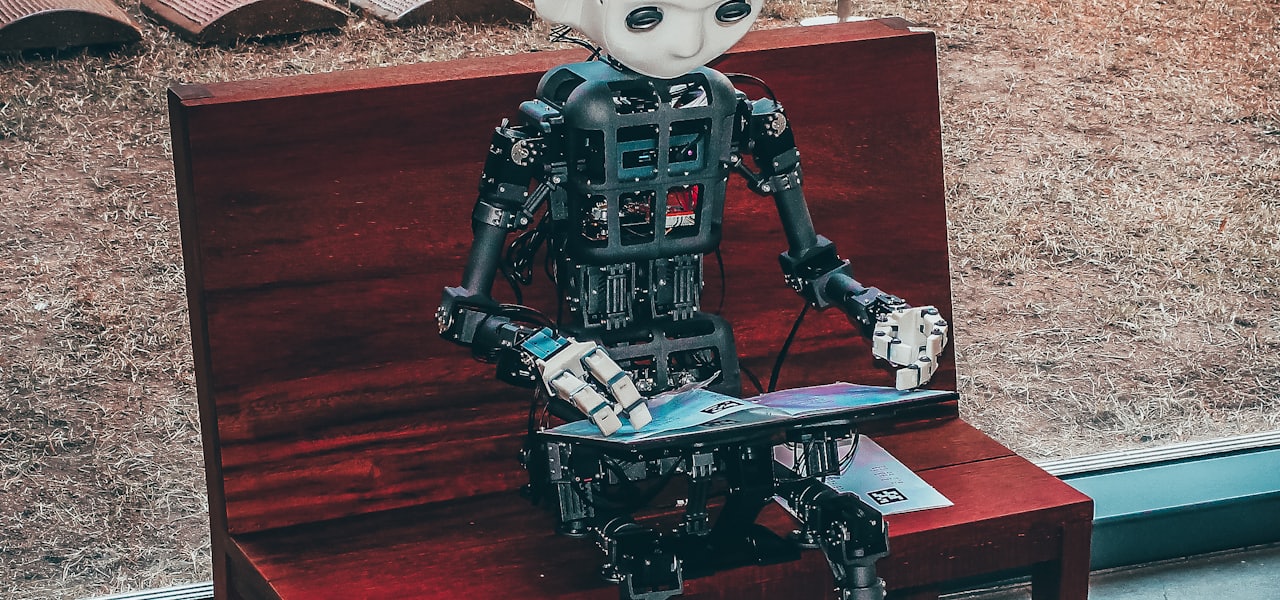
Ameca is a robotic humanoid created in 2021 by Engineered Arts, headquarters in Falmouth, Cornwall, United Kingdom. The project commenced in February 2021, and the first public demonstration was at the CES 2022 show in Las Vegas. Ameca's appearance features grey rubber skin on the face and hands, and is specifically designed to appear genderless. In 2024, an Ameca unit was installed in Edinburgh in the UK to reside at the National Robotarium. Ameca generation 3 has been released and showcased at ICRA 2025 along with Ami. == History == The first generation of Ameca was developed at Engineered Arts headquarters in Falmouth, Cornwall, United Kingdom. The project started in February 2021, with the first video revealed publicly on 1 December 2021. Ameca gained widespread attention on Twitter and TikTok ahead of its first public demonstration at the Consumer Electronics Show 2022, where it was covered by CNET and other news outlets. In 2022, Ameca presented an Alternative Christmas message by British TV Channel 4 for Christmas Day. Ameca was associated with the Museum of the Future's robotic family, where it could interact with visitors. In 2024, an Ameca unit was installed in Edinburgh in the UK to reside at the National Robotarium. In January 2026, Ameca served as an ambassador for the European Space Agency (ESA) at the 18th European Space Conference. == Features == It is designed as a platform for further developing robotics technologies involving human-robot interaction. utilizes embedded microphones, binocular eye mounted cameras, a chest camera and facial recognition software to interact with the public. Interactions can be governed by either OpenAI's GPT-3 or human telepresence. It also features articulated motorized arms, fingers, neck and facial features. Ameca's appearance features grey rubber skin on the face and hands, and is specifically designed to appear genderless. == Public appearances == Computer History Museum, California Heinz Nixdorf MuseumsForum, Paderborn, Germany Copernicus Science Center, Warsaw, Poland Museum of the Future, Dubai Consumer Electronics Show 2022 Deutsches Museum Nuremberg OMR Festival 2022 Hosted by Vodafone GITEX 2022 International Conference on Robotics and Automation 2023 International Telecommunication Union AI for Good Global Summit 2023 Sphere (Not Ameca, Custom humanoid named Aura built on Ameca technology)
Restricted Boltzmann machine
A restricted Boltzmann machine (RBM) (also called a restricted Sherrington–Kirkpatrick model with external field or restricted stochastic Ising–Lenz–Little model) is a generative stochastic artificial neural network that can learn a probability distribution over its set of inputs. RBMs were initially proposed under the name Harmonium by Paul Smolensky in 1986, and rose to prominence after Geoffrey Hinton and collaborators used fast learning algorithms for them in the mid-2000s. RBMs have found applications in dimensionality reduction, classification, collaborative filtering, feature learning, topic modelling, immunology, and even many‑body quantum mechanics. They can be trained in either supervised or unsupervised ways, depending on the task. As their name implies, RBMs are a variant of Boltzmann machines, with the restriction that their neurons must form a bipartite graph: a pair of nodes from each of the two groups of units (commonly referred to as the "visible" and "hidden" units respectively) may have a symmetric connection between them; and there are no connections between nodes within a group. By contrast, "unrestricted" Boltzmann machines may have connections between hidden units. This restriction allows for more efficient training algorithms than are available for the general class of Boltzmann machines, in particular the gradient-based contrastive divergence algorithm. Restricted Boltzmann machines can also be used in deep learning networks. In particular, deep belief networks can be formed by "stacking" RBMs and optionally fine-tuning the resulting deep network with gradient descent and backpropagation. == Structure == The standard type of RBM has binary-valued (Boolean) hidden and visible units, and consists of a matrix of weights W {\displaystyle W} of size m × n {\displaystyle m\times n} . Each weight element ( w i , j ) {\displaystyle (w_{i,j})} of the matrix is associated with the connection between the visible (input) unit v i {\displaystyle v_{i}} and the hidden unit h j {\displaystyle h_{j}} . In addition, there are bias weights (offsets) a i {\displaystyle a_{i}} for v i {\displaystyle v_{i}} and b j {\displaystyle b_{j}} for h j {\displaystyle h_{j}} . Given the weights and biases, the energy of a configuration (pair of Boolean vectors) (v,h) is defined as E ( v , h ) = − ∑ i a i v i − ∑ j b j h j − ∑ i ∑ j v i w i , j h j {\displaystyle E(v,h)=-\sum _{i}a_{i}v_{i}-\sum _{j}b_{j}h_{j}-\sum _{i}\sum _{j}v_{i}w_{i,j}h_{j}} or, in matrix notation, E ( v , h ) = − a T v − b T h − v T W h . {\displaystyle E(v,h)=-a^{\mathrm {T} }v-b^{\mathrm {T} }h-v^{\mathrm {T} }Wh.} This energy function is analogous to that of a Hopfield network. As with general Boltzmann machines, the joint probability distribution for the visible and hidden vectors is defined in terms of the energy function as follows, P ( v , h ) = 1 Z e − E ( v , h ) {\displaystyle P(v,h)={\frac {1}{Z}}e^{-E(v,h)}} where Z {\displaystyle Z} is a partition function defined as the sum of e − E ( v , h ) {\displaystyle e^{-E(v,h)}} over all possible configurations, which can be interpreted as a normalizing constant to ensure that the probabilities sum to 1. The marginal probability of a visible vector is the sum of P ( v , h ) {\displaystyle P(v,h)} over all possible hidden layer configurations, P ( v ) = 1 Z ∑ { h } e − E ( v , h ) {\displaystyle P(v)={\frac {1}{Z}}\sum _{\{h\}}e^{-E(v,h)}} , and vice versa. Since the underlying graph structure of the RBM is bipartite (meaning there are no intra-layer connections), the hidden unit activations are mutually independent given the visible unit activations. Conversely, the visible unit activations are mutually independent given the hidden unit activations. That is, for m visible units and n hidden units, the conditional probability of a configuration of the visible units v, given a configuration of the hidden units h, is P ( v | h ) = ∏ i = 1 m P ( v i | h ) {\displaystyle P(v|h)=\prod _{i=1}^{m}P(v_{i}|h)} . Conversely, the conditional probability of h given v is P ( h | v ) = ∏ j = 1 n P ( h j | v ) {\displaystyle P(h|v)=\prod _{j=1}^{n}P(h_{j}|v)} . The individual activation probabilities are given by P ( h j = 1 | v ) = σ ( b j + ∑ i = 1 m w i , j v i ) {\displaystyle P(h_{j}=1|v)=\sigma \left(b_{j}+\sum _{i=1}^{m}w_{i,j}v_{i}\right)} and P ( v i = 1 | h ) = σ ( a i + ∑ j = 1 n w i , j h j ) {\displaystyle \,P(v_{i}=1|h)=\sigma \left(a_{i}+\sum _{j=1}^{n}w_{i,j}h_{j}\right)} where σ {\displaystyle \sigma } denotes the logistic sigmoid. The visible units of Restricted Boltzmann Machine can be multinomial, although the hidden units are Bernoulli. In this case, the logistic function for visible units is replaced by the softmax function P ( v i k = 1 | h ) = exp ( a i k + Σ j W i j k h j ) Σ k ′ = 1 K exp ( a i k ′ + Σ j W i j k ′ h j ) {\displaystyle P(v_{i}^{k}=1|h)={\frac {\exp(a_{i}^{k}+\Sigma _{j}W_{ij}^{k}h_{j})}{\Sigma _{k'=1}^{K}\exp(a_{i}^{k'}+\Sigma _{j}W_{ij}^{k'}h_{j})}}} where K is the number of discrete values that the visible values have. They are applied in topic modeling, and recommender systems. === Relation to other models === Restricted Boltzmann machines are a special case of Boltzmann machines and Markov random fields. The graphical model of RBMs corresponds to that of factor analysis. == Training algorithm == Restricted Boltzmann machines are trained to maximize the product of probabilities assigned to some training set V {\displaystyle V} (a matrix, each row of which is treated as a visible vector v {\displaystyle v} ), arg max W ∏ v ∈ V P ( v ) {\displaystyle \arg \max _{W}\prod _{v\in V}P(v)} or equivalently, to maximize the expected log probability of a training sample v {\displaystyle v} selected randomly from V {\displaystyle V} : arg max W E [ log P ( v ) ] {\displaystyle \arg \max _{W}\mathbb {E} \left[\log P(v)\right]} The algorithm most often used to train RBMs, that is, to optimize the weight matrix W {\displaystyle W} , is the contrastive divergence (CD) algorithm due to Hinton, originally developed to train PoE (product of experts) models. The algorithm performs Gibbs sampling and is used inside a gradient descent procedure (similar to the way backpropagation is used inside such a procedure when training feedforward neural nets) to compute weight update. The basic, single-step contrastive divergence (CD-1) procedure for a single sample can be summarized as follows: Take a training sample v, compute the probabilities of the hidden units and sample a hidden activation vector h from this probability distribution. Compute the outer product of v and h and call this the positive gradient. From h, sample a reconstruction v' of the visible units, then resample the hidden activations h' from this. (Gibbs sampling step) Compute the outer product of v' and h' and call this the negative gradient. Let the update to the weight matrix W {\displaystyle W} be the positive gradient minus the negative gradient, times some learning rate: Δ W = ϵ ( v h T − v ′ h ′ T ) {\displaystyle \Delta W=\epsilon (vh^{\mathsf {T}}-v'h'^{\mathsf {T}})} . Update the biases a and b analogously: Δ a = ϵ ( v − v ′ ) {\displaystyle \Delta a=\epsilon (v-v')} , Δ b = ϵ ( h − h ′ ) {\displaystyle \Delta b=\epsilon (h-h')} . A Practical Guide to Training RBMs written by Hinton can be found on his homepage. == Stacked Restricted Boltzmann Machine == The difference between the Stacked Restricted Boltzmann Machines and RBM is that RBM has lateral connections within a layer that are prohibited to make analysis tractable. On the other hand, the Stacked Boltzmann consists of a combination of an unsupervised three-layer network with symmetric weights and a supervised fine-tuned top layer for recognizing three classes. The usage of Stacked Boltzmann is to understand Natural languages, retrieve documents, image generation, and classification. These functions are trained with unsupervised pre-training and/or supervised fine-tuning. Unlike the undirected symmetric top layer, with a two-way unsymmetric layer for connection for RBM. The restricted Boltzmann's connection is three-layers with asymmetric weights, and two networks are combined into one. Stacked Boltzmann does share similarities with RBM, the neuron for Stacked Boltzmann is a stochastic binary Hopfield neuron, which is the same as the Restricted Boltzmann Machine. The energy from both Restricted Boltzmann and RBM is given by Gibb's probability measure: E = − 1 2 ∑ i , j w i j s i s j + ∑ i θ i s i {\displaystyle E=-{\frac {1}{2}}\sum _{i,j}{w_{ij}{s_{i}}{s_{j}}}+\sum _{i}{\theta _{i}}{s_{i}}} . The training process of Restricted Boltzmann is similar to RBM. Restricted Boltzmann train one layer at a time and approximate equilibrium state with a 3-segment pass, not performing back propagation. Restricted Boltzmann uses both supervised and unsupervised on different RBM for pre-training for classification and recognition. The training uses contrastive divergence with